Farm Equipment For Rent
Owning farm equipment costs more than just the
purchase price. There are hidden expenses too, like repairs, maintenance,
storage, and the fact that machines lose value over time. This article looks at
those hidden costs and shows how renting equipment online can help you get the
heavy machinery you need — without paying the high price of buying it outright.
Machinery ownership has for a long time been something
of an indicator of a thriving farming business. It may well feel convenient to
have the tractor, combine, planter, or specialist equipment on standby, ready
for when you need it, but this convenience has a cost that extends well beyond
the purchase of the item itself. The true cost for farmers throughout the US
includes loans, depreciation, insurance, servicing, repairs, storage,
transport, fuel, and interest. This is where tractor rental in US options
and online rental marketplaces are changing how farmers think about access to
agricultural machinery. Not only will they no longer have to buy each machine
needed for seasonal or specialized tasks, but they also only pay for equipment
for the length of time they actually need to use it. This move is especially
useful to small- to mid-sized operations, as well as new and beginner farmers,
and those operations that require particular machinery on a more infrequent
basis. Online platforms are making this model easier by connecting farmers with
available machines in their area.
The purchase price is usually the number farmers focus on first. Sure, that's part of the picture - but it's only one part of it.
Suppose the farmer is looking for a high-value tractor to buy for a large farm business. Even if the tractor runs fine with no problems, it still loses value over time. As time progresses, the value of your equipment diminishes each year from technological progress and time spent operating and maintaining it, where sooner or later, a better option will enter the marketplace, with you continuing to pay for insurance, maintenance, storage, and repair needs.
It's also a bigger challenge if farmers only use a machine during a specific planting, spraying, or harvesting season. Some farmers will spend a total of thousands of dollars on a tractor that is used heavily for weeks and then just sits for months.
This downtime also comes with an unspoken cost in that
it's forgotten about by many farmers. Farmers also have to pay for
maintenance. Things such as tires, batteries, hydraulic equipment, oil and
grease, and even more obscure parts must be maintained or repaired if you are a
machine owner. In other words, owning it allows you to use it, but doesn't
guarantee use.
One of the unseen major costs of agricultural equipment is depreciation. Machinery can be a significant loss of value over time as it ages and is clocked with hours. When it's time to sell or trade it in, you might get much less money than what you originally paid.
Today's precision-farming tech, such as GPS, automated
controls, and better fuel efficiency, makes older machinery seem less appealing
in resale values.. Renting changes this equation. Instead of absorbing the
long-term depreciation of every machine, farmers pay for access during the
period when the machine creates value.
The cost of ownership becomes clearer when every expense is considered together. Farmers who buy equipment with a loan need to plan for the monthly payment.
So what are some of the ownership costs that we tend to ignore?
The problem with all these costs? It becomes difficult
to own equipment if you only really require the machine for certain jobs.
The biggest advantage of renting is simple: farmers pay for access instead of carrying the entire cost of ownership.
Suppose a farmer needs a specialized implement for ten days during a particular season. Buying that implement means paying for it throughout the year, including the months when it remains parked. You are letting the farmer rent and use a machine for that 10-day intensive period - not requiring them to invest in an entire year-long machine. This scenario can be attractive to farmers running specialty crops or having a season that requires a short investment, small farms, or a new type of production you are testing out.
Online rental markets just take things to another level of practical-ness. Instead of only checking the traditional rental yard, farmers can look for machinery based on dates and locations, or even what they want and what machine they need.
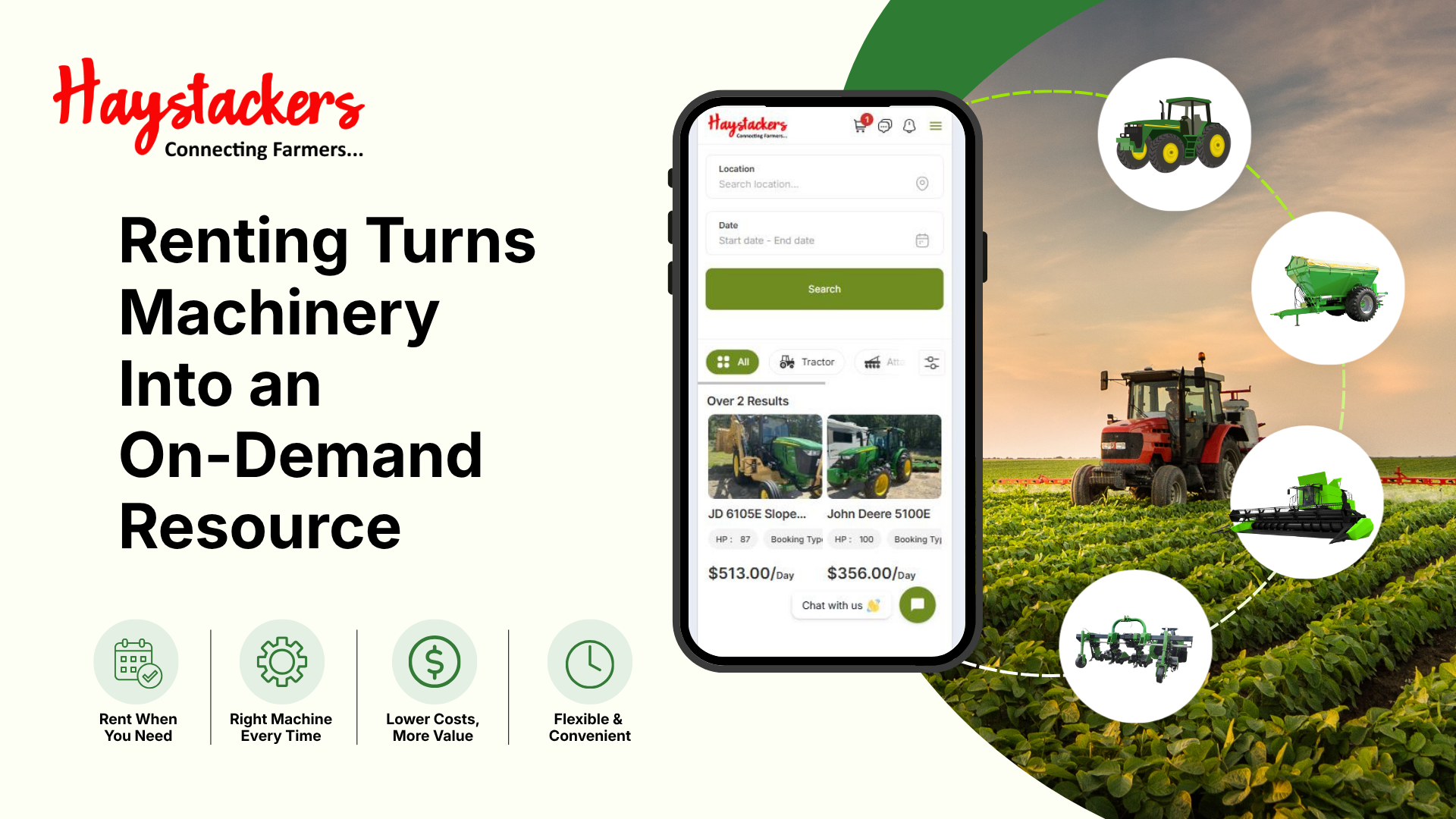
This is where systems like Haystackers become
necessary, operating off an access-based model. Here, machine owners grant
farmers who are seeking the machines use of their equipment. The Haystackers
marketplace is comprised of everything from tractors and combines to
harvesters, planters, attachments, sprinklers and drones. Through it, farmers
are able to find the machines closest to them, and owners are able to earn
income from the idle equipment.
Tractor Rental Agency
The answer would go something like this: it all depends on the utilization, maintenance costs, and whether your business needs an all-year-round resource.
| Pricing Consideration | Farm Machinery Investment | Agricultural Equipment Rental |
| Initial Investment | High | Low |
| Depreciation | The owner absorbs it | Generally not the renter's responsibility |
| Maintenance | Owner-managed | Typically handled according to rental terms |
| Storage | Required | Usually avoided by the renter |
| Insurance | Owner responsibility | Depends on rental agreement/platform |
| Seasonal Usage | Can create idle time | Pay mainly for required usage |
| Technology Upgrades | Requires new purchase | Access to different available models |
| Capital Flexibility | Money tied to assets | Capital remains available |
| Specialized Machinery | Expensive to own | Practical for short-term needs |
A high-use tractor that operates throughout the year may justify ownership. But purchasing every machine simply because it might be needed someday can tie up valuable capital.
Traditional rental companies have been around in agriculture for some time, but online marketplaces provide added convenience for rentals. This marketplace gives farmers the ability to scan available equipment, check its capabilities, see locations, interact with owners, and select rental times all from a central platform.
Haystackers, for example, has dubbed its marketplace a community-focused site where farmers can find machine owners in their area. It lets farmers search for available equipment, book a rental machine, chat with the owner, and even organize delivery or pickup of equipment.
Digital pipelines are being built up also on other marketplaces for the purchase and sale (or rental) of agricultural machines. Like Farm Gear Trader, for instance, which lists machines such as tractors, implements, harvest machines, attachments, hay and forage machines, and more.
The wider message is that, actually, a larger percentage of farmers are now happy to access machinery as a service they can use, rather than having an item they need to physically purchase and maintain.
Location Matters More Than Ever
One major advantage of digital marketplaces is the
ability to find machinery closer to the farm. For farmers, transportation can
quickly turn an apparently affordable rental into an expensive one. A nearby
machine can reduce hauling time, logistics, and transportation expenses.
Location-based discovery also makes peer-to-peer rental models interesting.
Farmers might be able to rent out unneeded equipment not just from big,
centralized rental fleets but also from fellow farmers in their community. This
could be a win-win. Renters could lease equipment for a few hours, days, or
weeks. Owners could rent out their idle equipment and make extra money.
As you'd expect, there's no right/wrong here. It boils down to your operation, your cash flow, when you plan on buying, and even which sort of machine you are buying. When deciding to buy any type of machine, farmers should determine their annual total cost of ownership, instead of looking just at the list price.
Add to this the cost of acquisition, finance and insurance, maintenance, repairs, storage, depreciation, transport, and the expected number of operating hours each year, and then divide by the total cost you'd expect to pay for hiring a similar type of machine for the number of days you need it.
For example, a specialized implement that you need for only a few days each year may be difficult to justify as an ownership purchase. A machine that you use almost every working day throughout the year may be a different case.
The key is to match the ownership decision with actual
utilization. Farmers looking at online marketplaces can also compare tractor
rental prices in US based on machine type, location, rental duration,
and availability before committing to a purchase.
The assumption most people make about renting is that it allows you to save a bit of money in the short term. What people don't always realize is that the monetary upside can last even longer.
Improve Payment Cycles and Cash Flow
It could take significant out-of-pocket money upfront and long-term debt obligations to acquire a big piece of equipment like that. Renting turns it into a steady operating expense rather than a hefty capital investment. And it frees up your money for seed, fertilizer, labor, irrigation, pesticides, soil amendments, and more.
Access to Specialized Machinery
Not every farm needs every type of machine. A farmer may need a drone for crop monitoring, a GPS monitor for precision work, a specialized planter for a particular crop, or a particular attachment for a short project. Renting makes these technologies accessible without requiring the farmer to purchase an entire specialized fleet.
Managing Risks in a Fast-Changing Digital Landscape
Agricultural technology will only keep changing.
Investing in an agricultural machine today might very well see you owning a
dated system only 3-5 years down the line. Rental offers farmers options to
test the technology/machinery prior to investing long-term.
Our entire agricultural economy is increasingly built around flexibility. We need to adapt to volatile weather patterns, volatile input costs, worker shortages, shifting market demand, and technology that advances so quickly our head will swim. Owning a big fleet can provide you with autonomy, but it's also going to strain your cash flow. Rental is an alternative to outright purchase.
That shift can encourage smarter capital allocation. A farmer can own the machines they use regularly while renting specialized or seasonal machines as needed. For farmers researching farm equipment rental in US, online marketplaces provide an increasingly practical way to explore available agricultural machinery without immediately committing to ownership. The same principle applies to machinery owners. An underused tractor or implement does not necessarily need to remain parked. Digital rental platforms can help owners put idle assets to work and potentially create an additional income stream.
Haystackers follows this peer-to-peer approach by
allowing owners to list machinery while giving renters access to agricultural
and industrial machines. The platform also highlights verified owners and
renters, insurance coverage, support, and local availability as part of its
marketplace model.
Farmers shouldn't just focus on the daily price tag when renting a piece of equipment. Here's a checklist of other things to examine: its overall shape, working specs, duration of rental, pick-up or delivery terms, rental agreement, insurance, payment terms, cancellation penalties, and extra fees..
Choosing the right equipment for the job at hand is another key factor. A cheaper rental machine might seem appealing, but not if it's unable to hold up in the specific terrain or type of work required. For those experimenting with digital rentals, exploring multiple listings will often yield the best range of equipment for both your needs and your budget.
Online access also makes planning easier. Farmers can
identify seasonal machinery requirements in advance and reserve machines
according to their production schedule. For those who want to understand the
broader rental model, it can be useful for them to learn about farm
equipment rental in online when evaluating how digital marketplaces
fit into modern farm operations.
It's true, there's a certain sense of ownership and autonomy that comes with purchasing your own farm machinery. However, it also brings along with it costs like depreciation, insurance, storage, financing, maintenance, repairs, and idle time. This is where renting offers a viable alternative. Farmers can obtain agricultural machinery when it's productive and not have all the costs of ownership 365 days a year.
Online rental marketplaces are making this more feasible: they allow you to link up with nearby machinery operators based on where your farm is located, when you need it, and what type of machinery your operation requires. Perhaps the most sensible plan isn't deciding whether to buy or rent, but rather both - you own the tractors and combines that run all the time while you rent the rest of your equipment.
Know More Today: Rent Smarter, Farm
Better.
1. Is renting farm machinery better than buying?
It depends on usage. Renting can be more practical for seasonal or specialized machines, while ownership may make more sense for machinery used frequently throughout the year.
2. What types of farm machinery can farmers rent on Haystackers?
A: Depending on the marketplace, farmers may discover tractors, harvesters, combines, planters, attachments, land mowers, sprinklers, and other agricultural implements.
3. Can machinery owners make money by renting out unused machines?
A: Yes. Online peer-to-peer marketplaces can help owners list underused machinery and connect with farmers who need short-term access, creating a potential additional revenue stream.
More articles





Haystackers is a peer to peer community-based platform facilitating direct rentals of tractors and farm equipment from individual farmers to those in need.
© Copyright 2026. Haystackers. All Rights Reserved.


© Copyright 2026. Haystackers. All Rights Reserved.